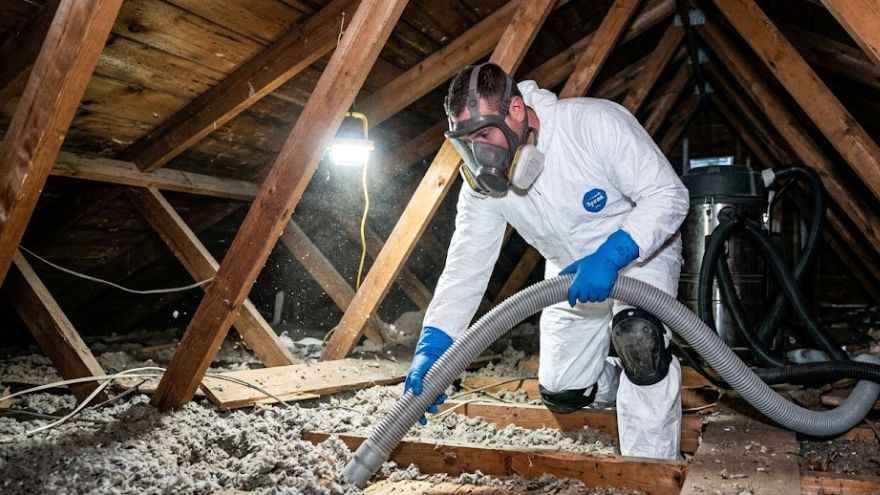
The question of whether attic insulation needs to be replaced after a rodent infestation is one of the most common decisions we help Lubbock homeowners navigate. The answer isn't always replacement, but it isn't always cleanup either. The determination depends on two factors: the extent of urine saturation and the degree of compression damage. This guide explains how to assess both and what the replacement decision looks like for different infestation severities.
When cleanup-in-place is appropriate.
Time matters. Damage compounds.
Targeted nest and droppings removal with surface disinfection is appropriate when: the droppings are concentrated in a specific area of the attic (under a particular section of the roof line or near one nesting site), the surrounding insulation is not visibly soiled or discolored by urine, the odor in the attic is not persistent after the nest material is removed, and the overall insulation loft in unaffected areas is adequate. In this scenario, removing the affected material, disinfecting the surrounding surface, and adding blown-in insulation to the areas where material was removed is the correct approach.
When replacement is warranted.
Wait too long and the bill grows.
Full replacement is the right call when: urine saturation is visible (discolored insulation, persistent ammonia odor when the material is disturbed) across more than 20–25% of the attic floor area, compression from nesting and rodent traffic has reduced the overall insulation loft significantly across a large section, or the pre-existing insulation was already below current R-38 standards and the contamination creates an opportunity to upgrade. The combination of contamination removal and R-38 upgrade in a single replacement project addresses both the health concern and the thermal performance gap simultaneously.
The R-38 opportunity.
Many Lubbock homes in Tech Terrace, Overton, Heart of Lubbock, and Dunbar Manhattan Heights have original insulation from the 1960s or 1970s at R-11 to R-19. The Energy Star recommendation for Lubbock's Climate Zone 3 is R-38. Replacing soiled insulation with blown-in fiberglass at R-38 upgrades the home's thermal performance significantly. The energy savings over a Lubbock summer with a properly insulated attic are real and measurable. For homeowners facing a replacement decision, the insulation upgrade argument is worth including in the cost-benefit calculation.
How we assess insulation condition.
Done correctly the first time saves the second call.
Our attic cleanup visits include an insulation condition assessment as a standard step. We evaluate saturation extent, loft measurement in affected vs. unaffected areas, and overall condition. We give you a clear honest recommendation, we don't recommend replacement when cleanup is enough, and we don't recommend cleanup when replacement is the better answer. The assessment is included in the cleanup visit at no additional charge. See our insulation replacement service for the full program and pricing.
Related articles.
What insulation replacement actually costs in Lubbock: and what affects the range.
Property-specific. Not a flat menu.
Attic insulation replacement in Lubbock typically runs $1.50 to $3.00 per square foot installed for blown-in fiberglass or cellulose, which translates to $1,500–$3,000 for a 1,000 square foot attic footprint and $3,000–$6,000 for a 2,000 square foot footprint. The spread is driven by three variables: removal cost (removing soiled insulation is labor-intensive and adds $0.50–$1.00 per square foot), target R-value (upgrading to R-38 or R-49 adds material cost over like-for-like replacement), and access complexity (attics with low clearance, multiple HVAC units, or irregular framing take more labor hours). Most Lubbock roof-rat infestations that require replacement affect the sections of attic where the colony nested, typically under the roof deck near the eave line, rather than the entire attic floor, so partial replacement is sometimes appropriate.
Texas insurance and rodent damage: what most Lubbock homeowners don't know.
Standard Texas homeowners insurance policies exclude rodent damage under the "infestation" exclusion, which is broadly written to cover all pest-related damage including rats, mice, and squirrels. This means insulation replacement, wire repair, and HVAC remediation from rodent damage is almost always an out-of-pocket expense. There are two exceptions worth knowing. First, if the rodent damage causes a covered peril: for example, a rat-chewed wire causes an electrical fire, and the fire damages the attic, the fire damage is covered even though the underlying cause was a rodent. Second, some high-end home policies with broader endorsements cover "sudden and accidental" damage, which a claims adjuster might apply to a documented electrical short caused by rodent gnawing. Documenting the wire damage with photographs before repair is worth doing regardless, because it preserves the option to file a claim if secondary damage occurs.
The R-38 opportunity: why replacement is sometimes worth doing even when cleanup-in-place would suffice.
Lubbock's climate, hot summers with July averages above 93°F and significant heating loads in winter, makes attic insulation R-value one of the highest-ROI home improvements available. Many Lubbock homes built before 1990 have attic insulation at R-19 to R-25, which is significantly below the current energy code recommendation of R-38 for Climate Zone 3. When a rodent infestation creates the conditions for partial or full insulation replacement, the incremental cost of upgrading to R-38 rather than replacing in-kind is relatively small: the removal and installation labor is already being paid, and the additional blown-in material for a 1,000 square foot attic to go from R-19 to R-38 adds roughly $300–$600 to the material cost. The energy savings from the upgrade in a Lubbock home, reduced cooling loads in summer, reduced heating loads in winter, typically pay back that incremental cost within two to four heating-cooling seasons. We flag this opportunity during every insulation assessment, because it's genuinely in the homeowner's interest and easy to miss when the focus is on the colony rather than the long-term building performance.