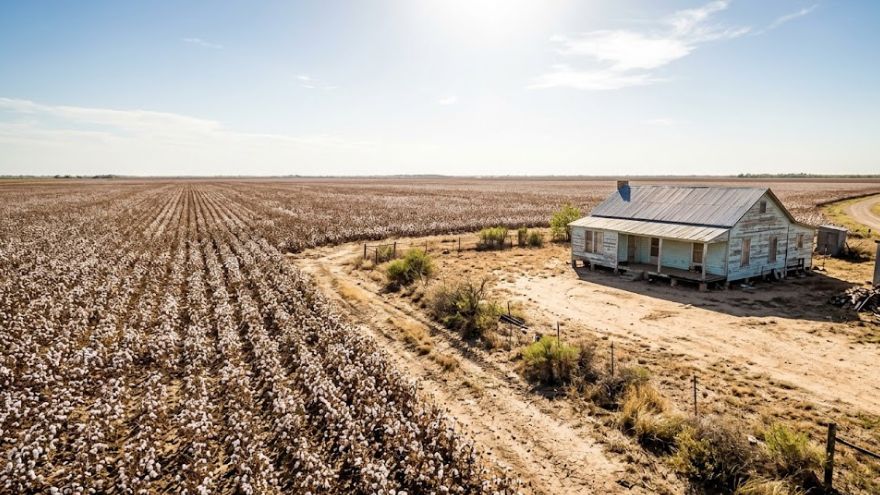
Lubbock County's agricultural character creates a rodent pressure dimension that doesn't exist in more purely urban markets. Properties near active farmland: whether residential subdivisions built into former cotton fields, oilfield operations near agricultural land, or the rural properties that haven't been developed, experience rodent pressure from a much larger reservoir than urban properties face. This guide covers why agricultural-edge pressure is different and what it means for control approaches.
The agricultural rodent reservoir.
Active farmland sustains large field rodent colonies through the growing season. Cotton, sorghum, and grain fields provide both food (from the crop itself and from post-harvest residue) and shelter (in crop canopy during the growing season, in straw and residue after harvest). These field populations are primarily field mice (Mus musculus and Peromyscus species), but Norway rat colonies near grain storage and feed operations can be large and persistent.
The reservoir population adjacent to a developing subdivision or rural property is orders of magnitude larger than the urban rodent colony near a central Lubbock neighborhood. A 100-acre cotton field on the edge of Wolfforth can sustain several thousand field mice. When cold weather or harvest disruption pushes that colony toward residential construction at the field edge, the colony pressure is substantially higher than anything a mid-city Lubbock neighborhood faces.
Harvest-season displacement.
Cotton and grain harvest in October and November, which coincides with the cold-front season for roof-rat pressure, creates additional displacement pressure. Harvest machines disturb the field population; residue management removes shelter; and the disruption pushes large numbers of field mice toward the nearest alternative shelter, which is residential construction at the field edge. The intersection of cold-front season, harvest season, and agricultural-edge location produces the highest rodent pressure events we see anywhere in our service area.
What agricultural-edge programs look like differently.
Standard residential exclusion remains the foundation: weep holes, door sweeps, utility penetrations. But the exterior bait station program matters more at agricultural-edge properties than in urban locations, because the ongoing pressure from the field reservoir means that even a well-sealed home needs a perimeter interception program to prevent population buildup at the foundation before animals find the remaining entry points. Monthly exterior station service is the right rotation frequency for properties within 500 feet of active farmland; bi-monthly service works for properties farther from the field edge.
Which Lubbock-area communities have the highest agricultural-edge pressure.
Wolfforth and Shallowater have seen significant residential development into former agricultural land and have some of the highest agricultural-edge pressure of any community in our service area. Newer subdivisions in the southern and eastern development corridors of Lubbock proper have similar dynamics. The rural towns, Abernathy, Floydada, Tahoka, Levelland, are surrounded by farmland and experience harvest-season pressure city-wide rather than just at the perimeter.
See our agricultural rodent control program for farm and ranch property programs, and our Wolfforth and Shallowater area pages for the specific pressure profiles in those communities.
Related articles.
How Lubbock County's crop rotation calendar maps to rodent pressure months.
Order matters. Skip a step and the cycle restarts.
Understanding the specific crop rotation calendar in Lubbock County helps predict when agricultural-edge pressure will peak. Cotton, the dominant crop in Lubbock County, is harvested from October through November, with gin operations running through December. The harvester equipment moving through fields in October is the primary displacement event: field mice and Norway rats that have built up through the growing season are suddenly without cover and food, and the nearest permanent structures become the destination. Grain sorghum, where it's rotated in on the same fields, is harvested in September and October, sometimes creating a two-wave pressure event for properties adjacent to fields with mixed rotation. Winter wheat, which is planted in October through December and harvested the following June, creates a lower-intensity but longer-duration field mouse habitat through the spring months. Properties adjacent to winter wheat fields see a second, milder pressure event in June when wheat harvest occurs.
What treatment looks like different on agricultural-edge properties.
Standard residential rodent programs are designed around a bounded infestation: identify the current population, eliminate it, and seal entry points to prevent recurrence. Agricultural-edge programs require a continuous-pressure model instead, because the reservoir source (adjacent farmland) never goes away. This means perimeter bait station programs designed to intercept field rodents before they reach the structure, rather than interior trap programs designed to eliminate an established interior population. It means monitoring visits timed to the agricultural calendar: October harvest inspection, February post-winter inspection, June wheat-harvest inspection for properties adjacent to winter wheat. And it means exclusion work that accounts for the volume of pressure rather than just the current infestation: more weep-hole sealing, more foundation vent screening, and more attention to door-threshold gaps than a standard residential program requires.
Which Lubbock-area properties are most at risk: and why.
Agricultural-edge rodent pressure is not evenly distributed across Lubbock County. The highest-risk properties share a specific combination of characteristics: direct adjacency to active farmland (within 300 yards of a cultivated field), older construction with degraded exclusion barriers, and the absence of a maintained landscape buffer between the structure and the field edge. New construction in Wolfforth, Shallowater, and the south Lubbock Loop 289 expansion zone, where residential development has moved into former cotton fields, represents the highest-volume new category of agricultural-edge calls we see. These properties don't have the history of entry-point accumulation that older construction does, but they sit directly at the field interface in a way that decades-old interior Lubbock construction does not. For established construction in Abernathy, Floydada, Hale Center, and similar Hockley and Floyd County communities, the risk is high because both conditions are present: direct field adjacency and decades of entry-point accumulation. The combination is more challenging than either factor alone.