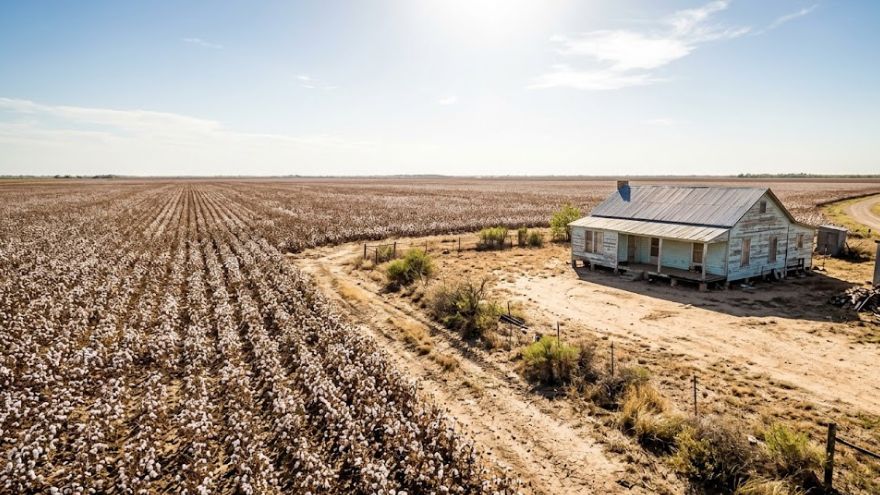
Oilfield and farm properties on the South Plains present rodent control challenges that residential and standard commercial programs aren't designed for. The scale, the remote locations, the specific attractants (grain, grease, food waste from field crews), and the operational constraints of active extraction and farming operations require a purpose-built approach. This guide covers the key differences and what effective programs look like for each property type.
Oilfield properties: the specific pressures.
Oilfield operations on the South Plains: concentrated in Garza, Dawson, Lynn, and Borden counties within our service range, create rodent conditions through multiple mechanisms. Man camps generate food waste and have the structural gaps of modular construction. Equipment yards have dark, undisturbed container and vehicle storage that serves as ideal shelter. Active drilling pads disturb natural predator habitat: raptors that nest near the site relocate, snake populations that live in undisturbed terrain are displaced, and the rodent colonies that those predators naturally suppressed expand in their absence. Tank battery sites and separator stations have warm mechanical spaces with vibration that attracts burrowing rodents to the stable warm ground nearby.
The practical result is that oilfield sites often have severe rodent problems that are discovered only when a crew member reports activity in a man camp unit or when wiring damage on equipment is found. We've built programs around these conditions: exterior bait station networks at man camp perimeters, drive-aisle and container-row trap programs in equipment yards, and entry-point sealing at man camp skirting and utility penetrations.
Farm properties: the grain storage dimension.
Farm rodent control is dominated by one location: the grain bin. Norway rats establish burrow systems under and around grain storage structures, accessing spilled grain and the bin interior through gaps at the foundation course. A large grain storage facility can have dozens of active Norway rat burrow systems under adjacent concrete that have been established for years. Left unaddressed, the burrows undermine the concrete slab, the colony extends into adjacent outbuildings and eventually into any residential structure on the property, and grain contamination and spoilage losses accumulate season after season.
Effective farm rodent control treats the grain storage perimeter as the primary zone: commercial-grade bait stations at the bin perimeter (not consumer stations: commercial stations are rated for the moisture and temperature conditions at a grain bin foundation), burrow treatment and collapse of active burrow systems before the new season, and structural exclusion of foundation gaps where the Norway rat access concentrates.
Service documentation for agricultural operations.
Farm and oilfield operations often need service records for crop insurance, USDA program compliance, or oilfield HSE (Health, Safety, Environment) file documentation. We generate service records after every visit formatted for the specific documentation need: FSMA-aligned records for food-adjacent agricultural storage, HSE-formatted records for oilfield operator files, and standard service reports for crop insurance or general record-keeping purposes.
Coverage area for agricultural and oilfield programs.
Our agricultural service area extends from Lubbock County into Hockley, Lamb, Floyd, Crosby, Lynn, Garza, Dawson, Borden, and Scurry counties. For properties more than 45 minutes from Lubbock, a mileage component is quoted transparently before scheduling. Multi-property portfolios are quoted on a portfolio basis with flat per-property rates.
See our agricultural rodent control and oilfield rodent control service pages for program details and coverage area.
Related articles.
Man-camp and worker housing rodent control: the rotation access problem.
Oilfield worker housing: whether temporary man-camp structures or permanent company-provided housing near active operations, presents a specific rodent control challenge that isn't present in standard residential or commercial service: the rotation access problem. When worker populations rotate on two-week or four-week schedules, the housing is periodically unoccupied, housekeeping standards vary between rotation groups, and food-waste management is inconsistent. This creates ideal conditions for rodent establishment during the unoccupied periods. Norway rats and house mice move into dormant structures quickly, within days of occupancy decreasing, and an established colony can develop in a single rotation cycle. Effective man-camp programs require perimeter bait station programs that maintain population pressure during occupied and unoccupied periods, interior inspection timed to rotation changeover, and written protocols for food-waste disposal that housekeeping personnel can follow reliably.
Pump station and pipeline infrastructure programs.
Individual pump stations are some of the most rodent-favorable structures on the South Plains: they provide the protected, below-grade access that Norway rats prefer, they generate residual food waste from maintenance crew activity (food wrappers, grease-soaked rags), and they're rarely inspected for rodent activity between scheduled maintenance visits. An active pump-station rodent colony can damage insulation on instrumentation wiring, contaminate lubricant storage areas, and create a Norway rat reservoir that pressures any adjacent residential or agricultural structure within a few hundred yards. Pump-station programs use exterior bait stations placed on confirmed Norway rat runways around the structure perimeter, combined with entry-point assessment of the building skin: focusing on conduit entry sleeves, pipe chases, and the foundation-grade interface where Norway rat burrow activity begins.
Seasonal timing for South Plains oilfield and farm programs.
Agricultural and oilfield rodent programs on the South Plains require timing that aligns with the agricultural calendar rather than the standard spring-fall residential inspection cycle. The highest-pressure period for farm properties is October through November, cotton harvest displaces established field populations toward farm structures. The second-highest pressure period is June, winter wheat harvest creates a smaller but real pressure spike for properties adjacent to wheat rotation fields. For oilfield properties, seasonal timing is less relevant because the pressure source (permanent infrastructure harborage) is year-round, but quarterly inspections timed to the beginning of each calendar quarter provide coverage across the full range of seasonal conditions. We recommend pre-harvest inspection in late September for all farm properties, assessing and reinforcing exclusion before the displacement event rather than responding to it after the fact. This proactive timing reliably reduces the severity of the fall pressure spike compared to reactive-only programs.