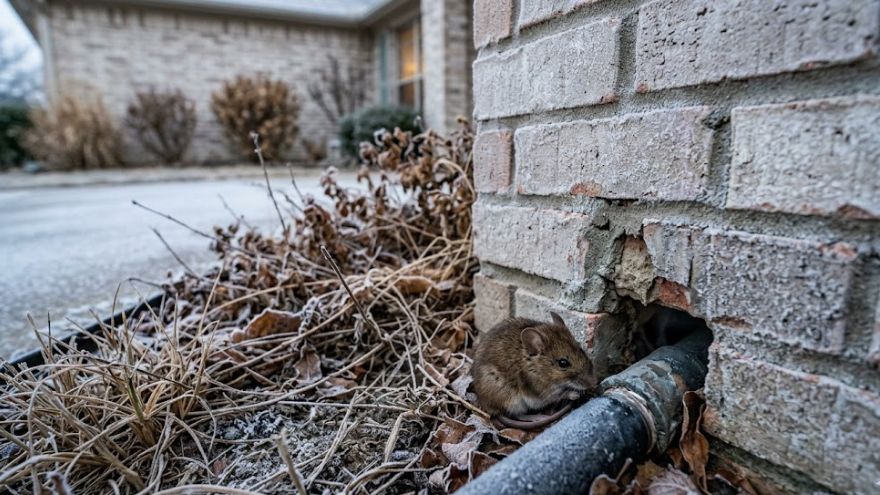
Rain is unusual enough in Lubbock that it generates its own set of rodent dynamics. The South Plains averages around 18 inches of annual rainfall, which makes heavy rain events: particularly the thunderstorm activity from April through June and the occasional tropical remnant that reaches the Llano Estacado, significant disruption events for the rodent colonies that live in burrows, ground cover, and low-lying areas. The spike in rodent calls we see after significant rain events follows a predictable pattern that homeowners can prepare for.
How rain displaces Norway rats from burrows.
Done correctly the first time saves the second call.
Norway rats are ground-level burrowers. Their burrow systems under concrete slabs, foundation perimeters, and landscaping depend on the soil staying dry enough to maintain the burrow structure. A heavy rain event, particularly 2+ inches over 24 hours, which does occur in Lubbock during severe thunderstorm events, can partially or fully flood burrow systems in areas with poor drainage. Flooded burrow systems force the resident rats to surface immediately, and they then seek the nearest dry elevated shelter: residential foundations, commercial dumpster areas, garages, and any structure with accessible gaps at ground level.
The day after a heavy rain is one of our higher-volume call periods for Norway rat calls, particularly from commercial properties near downtown and from residential properties close to drainage channels and low-lying ground. The flood-displaced rats are actively probing for new shelter, which means they're testing every potential entry point along your foundation perimeter more quickly than they would under normal conditions.
How rain affects house mice and field rodents.
Sequence over speed.
House mice in wall voids and attic spaces are less directly affected by rain, they're already inside. But field mouse colonies in the agricultural areas surrounding Lubbock, and in the green spaces within the city, are displaced by saturated ground in the same way as Norway rats. A field mouse that was living in vegetation at the edge of a commercial parking lot or along a drainage ditch is driven toward elevated, dry structures when the ground becomes saturated. This creates secondary pressure on residential properties near green spaces, parks, and agricultural land edges.
What to check after a significant Lubbock rain event.
Spot it early. Save the wall.
After any rain event that produces more than 1 inch of accumulation, check the following before the 48-hour post-rain window closes: the exterior foundation perimeter for new Norway rat burrow openings (fresh soil disturbance near the foundation, or holes 2–3 inches in diameter), the garage perimeter for fresh gnaw marks or new droppings (displaced animals probe garage door seals first), and any low-lying exterior entry points, weep holes, foundation vents, drain covers, for evidence of recent traffic. If you find new activity evidence within 48 hours of a significant rain, the source is almost certainly displaced animals from a saturated ground event rather than a pre-existing colony.
Long-term rain effects on rodent population cycles.
Years with above-average rainfall in Lubbock, which do occur, particularly in El Niño years, tend to produce higher rodent pressure the following year. The mechanism is plant growth: higher rainfall produces more ground cover, more food resources (seeds, grain spills), and more nesting habitat, which supports higher rodent colonies through the spring and summer. By the time the following October cold fronts arrive, the field-edge rodent reservoir is larger than in a dry year, which increases the peak pressure on residential construction.
If you see new rodent activity after a rain: The 48-hour window after a significant rain event is when displaced animals are most actively probing for new shelter, and when sealing the foundation-level entry points is most urgent. Call (806) 207-3665 for same-day inspection if you see new evidence after a Lubbock rain event.
Related articles.
The specific rainfall threshold that displaces Norway rats: and how Lubbock's events compare.
Norway rat burrow systems are engineered for drainage: active burrows have a characteristic downward-sloping main tunnel that allows water to drain away from the nest chamber. In most rainfall events, the drainage design is enough and rats remain in place. The displacement threshold is typically a sustained event that delivers more than 1.5 to 2 inches in 24 hours at a location with high water table or compacted clay soil, both conditions present in parts of Lubbock County. Lubbock averages only 18 inches of annual rainfall, so events exceeding the displacement threshold are relatively rare, but when they occur, they're significant. The August 2022 event that delivered over 3 inches in parts of south Lubbock in under six hours produced a measurable spike in Norway rat calls in the days following, consistent with the burrow-flooding displacement pattern. The semi-arid climate means rats are less adapted to significant rain events than populations in wetter climates, so even moderate flooding relative to national standards can produce displacement behavior in Lubbock's Norway rat colonies.
Post-rain inspection priorities: what changed during the event.
Rain events change entry-point conditions in ways that aren't always visible from a normal exterior inspection. Soil settlement around foundation penetrations, where the soil has been disturbed by previous plumbing or electrical work, accelerates after a rain event, widening gaps at the grade-foundation interface. Weep-hole mortar that was marginally intact can wash away or soften, opening access that wasn't present before the event. Foundation cracks that have been stable can admit water under hydrostatic pressure, and the saturated soil surrounding the crack creates Norway rat burrowing conditions directly against the foundation. A post-rain inspection within 72 hours of a significant event, particularly for properties with known Norway rat activity or properties adjacent to agricultural drainage, identifies these new access conditions before they become established entry routes.